
Cabin Portal
The web platform provides valuable data insights to support informed decision-making and optimize maintenance strategies.
Cabin Portal
Principles
The Cabin APP Portal offers powerful features designed to optimize aircraft cabin maintenance, thanks to powerful principles:
- Exhaustive data base: Access and analyze comprehensive maintenance data for deeper insights.
- Reporting Capabilities: Dedicated reports available instantly with key KPIs on Aircraft, Passenger Class, Recurring Items... etc.
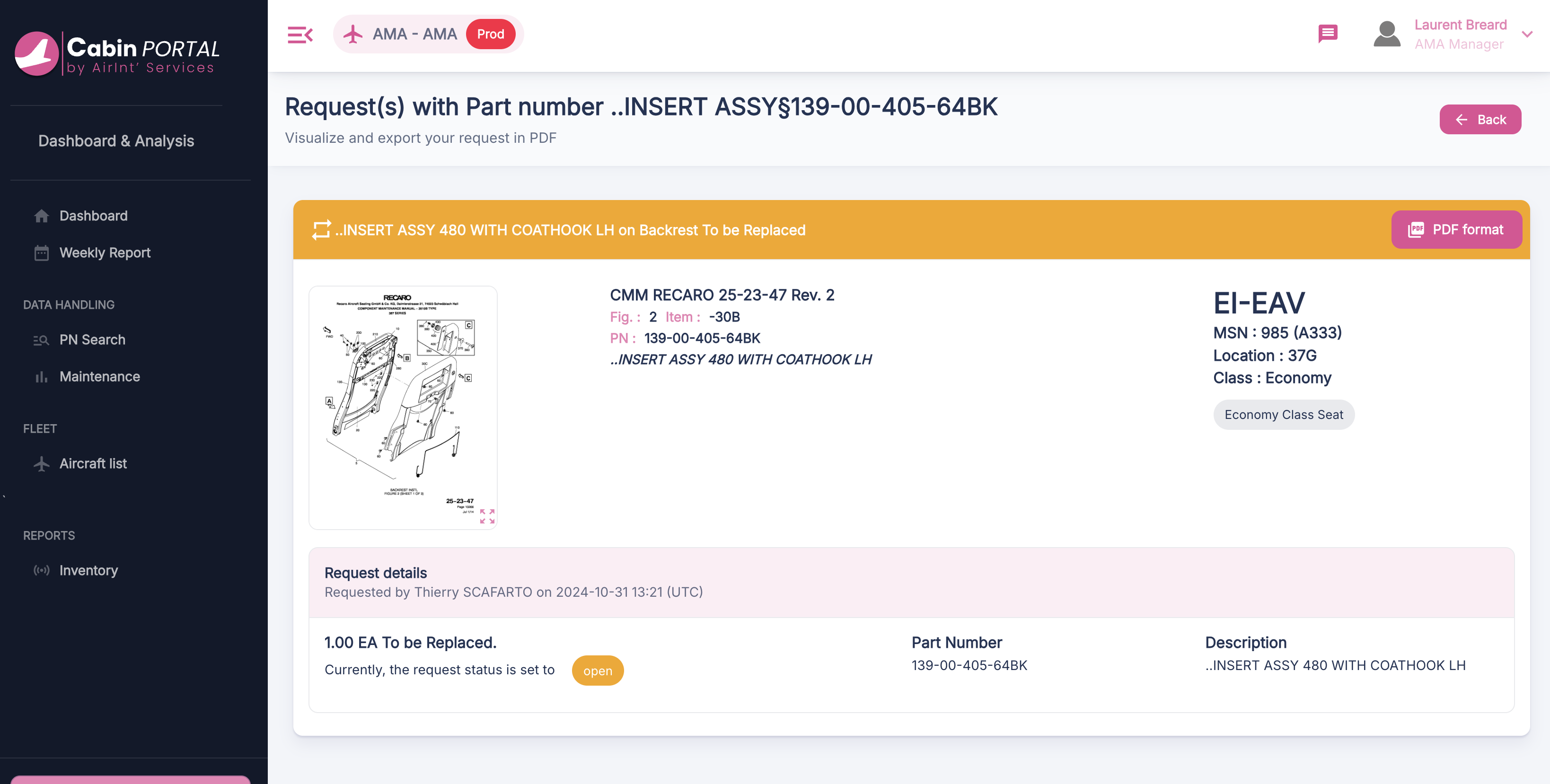
- Visual Support: Ability to make the right decisions thanks to the vizualisation of 3D, Lopa, Technical Figures, Photos... etc.
- Full Traceability: Get access to any period of your maintenance records.
- Tech Data: Get benefits of the enhancement of technical document for improved equipment reliability and warranty claims.
- Decision Effectiveness Monitoring: Tracking and measuring the impact of decisions.
Cabin Portal
Key Benefits

Maximize revenue and cut costs with Cabin Portal:
- Fly more: Cabin is no longer the bottleneck of aircraft stops as resources can be allocated pro-actively.
- Cabin Appearance: Prioritize and address passenger-facing maintenance issues for a more comfortable flying experience.
- Warrany Claims: Easily track and document defective parts to streamline the warranty claims process.
- Seat Availability: Predict and prevent critical component failures to minimize seat outages.
- Crew Efficiency: Ensure galley inserts are readily available for efficient crew operations and passenger service.
Cabin Portal
Discover our modules
We propose multiple optionnal modules to fit to your needs:
Data Cube
Visualize all maintenance data whatever your perspective (Aircraft, Class, Part Number, Priority… etc.)
Cabin Portal
Focus on our infrastructure
Security:
- Robust Security Practices: Implementation of industry-standard security practices, including regular security audits, vulnerability assessments, and penetration testing.
- Your Access Controls: We implement your SSO whatever the standard (Microsoft AD, SAML, OAuth).
- Secure Containerization: Utilization of secure containerization techniques to isolate applications and reduce the attack surface.
- Network Segmentation: Isolation of critical services and data using network segmentation to minimize the impact of potential breaches.
- Regular Patching and Updates: Timely application of security patches and updates to address vulnerabilities.
- Secure Communication: Encryption of data in transit and at rest using industry-standard encryption protocols.
- Web Application Firewall (WAF): Deployment of a WAF to protect against common web attacks.
- Intrusion Detection and Prevention Systems (IDPS): Implementation of IDPS to monitor network traffic and detect and block malicious activity.
Availability:
- High Availability Architecture: Design of a highly available architecture with redundancy and failover mechanisms.
- Load Balancing: Distribution of traffic across multiple instances to improve performance and reliability.
- Automated Deployment and Scaling: Use of automated deployment and scaling tools to ensure rapid deployment and efficient resource utilization.
- Continuous Monitoring: Real-time monitoring of system health and performance metrics.
- Automated Incident Response: Implementation of automated incident response procedures to minimize downtime.
- Regular Backups: Regular backups of data to ensure data recovery in case of disasters.
- Disaster Recovery Plan: A well-defined disaster recovery plan to minimize the impact of disruptions.